
CGT Changes- Apportioning The PRE 2027 Discount And Post 2027 Indexed Gains – Part 1
The capital gains tax (CGT) changes enacted by the Australian Government represent one of the most significant reforms to the taxation of investment assets since the introduction of the CGT regime in 1985. Although much of the public debate surrounding the reforms has focused on housing affordability and the accessibility of residential housing for owner-occupiers, the legislative changes extend well beyond the housing sector and have important implications for investors, developers, private groups and foreign residents.
Recognising that many taxpayers had acquired assets and made investment decisions on the basis of the existing capital gains tax framework, the legislation includes grandfathering rules designed to preserve the treatment of gains that accrued before the commencement of the new regime on 1 July 2027. Rather than applying the new indexation framework to the entire gain realised on a future disposal, the legislation separates gains that arise before and after the commencement date. This is achieved through the deemed disposal and reacquisition mechanism, which effectively treats an asset as having been disposed of immediately before 1 July 2027 and reacquired on that date for its market value or an amount determined under the statutory apportionment methodology.
There are two methods for calculating the capital gain pre and post 30 June 2027. The first is to simply adopt the market value where it is available at 30 June 2027.
The second is the apportionment methodology. The apportionment methodology is set out in the Income Tax Assessment (Method for Apportioning Capital Gains and Capital Losses) Determination 2026. The Explanatory Statement states that the instrument prescribes an apportioning method for particular CGT assets, dividing an overall capital gain or capital loss between the ownership period prior to 1 July 2027 and the ownership period from 1 July 2027 to the sale date.
The method is available for real property (real estate) and for CGT assets that do not have a readily ascertainable market value, provided the asset’s cost base is not otherwise worked out by reference to market value under another provision outside the deemed sale and reacquisition rules. The Explanatory Statement notes that listed shares would generally have a readily ascertainable market value, whereas some private company shares may not, particularly where control premiums affect the value of different holdings. It would be expected that Goodwill would also not have a readily ascertainable market value, absent engaging a licensed business valuer.
The methodology is based on a compounding daily growth rate. It assumes that the asset grew, or declined, at a daily compounded rate over the entire ownership period. That rate is then used to estimate the capital proceeds of the deemed sale just before 1 July 2027. The resulting deemed capital proceeds are used to calculate the deferred pre-start date gain or loss and to set the cost base at the start date for the post-1 July 2027 calculation.
The Determination sets out a nine-step process. In substance, these nine steps can be achieved in seven steps, where the taxpayer must:
- Work out the cost base and reduced cost base of the CGT asset at the end of 30 June 2027.
- Divide the capital proceeds from the realisation event by the first element of the pre-start date cost base to determine the total growth rate.
- Work out the number of days the asset has been held over the full ownership period and the number of days it was held until 30 June 2027.
- Calculate the daily growth rate using the prescribed formula.
- Calculate the pre-start date capital proceeds using the daily growth rate.
- Determine the capital gain or capital loss from the deemed disposal.
- Treat the pre-start date capital proceeds as the cost base at the start date.
- Work out the post-start date cost base and reduced cost base at the time of the realisation event, including indexation where applicable.
- Calculate the post-start date capital gain or capital loss by comparing the actual capital proceeds with the post-start date cost base or reduced cost base.
This methodology is significant because it gives taxpayers a statutory alternative to obtaining a formal market valuation as at 30 June 2027 for qualifying assets. It also introduces a more computational approach to allocating gains across the reform date, which will require careful record keeping and, in many cases, modelling support from advisers.
Example- applying methodology
Assume:
- Sarah purchases a commercial property on 1 July 2018 for $500,000.
- Sarah sells the property on 30 June 2030 for $900,000.
- The property qualifies for the statutory apportionment methodology.
- No acquisition or disposal costs are incurred.
- CPI increases by 4% per annum after 1 July 2027.
- Rather than obtaining a formal valuation at 30 June 2027, Sarah elects to apply the statutory apportionment method.
Step 1 – Calculate the Total Growth Rate
The Determination first requires the taxpayer to determine the overall growth in value of the asset across the entire ownership period.
Item Amount
Sale proceeds $900,000
Original cost base $500,000
Total growth rate 1.8
The total growth rate is:
$900,000/$500,000=1.8
This means the property increased in value by 80% over the ownership period.
Step 2 – Calculate the Daily Compounded Growth Rate
The property was owned as follows:
Period Days
Total ownership period (1 July 2018 to 30 June 2030) 4,383
Pre-1 July 2027 ownership period 3,287
The Determination assumes the property grew at a compounded daily rate throughout the ownership period. The daily growth factor can therefore be estimated as:
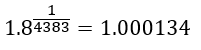
This suggests the property increased in value by approximately 0.0134% per day on a compounded basis.
Step 3 – Estimate the Value at 30 June 2027
The next step is to estimate what the property would have been worth immediately before 1 July 2027.
The Determination effectively applies the daily growth factor to the original cost base for the period ending 30 June 2027:

Accordingly, the statutory methodology produces a deemed value of $776,500 as at 30 June 2027.
This is essentially the figure you would compare against the independent market value obtained from a licensed valuer as at 30 June 2027 to determine whether using this method or an independent gave your client a better CGT outcome.
In part 2 of the article to be issued in our Summer QTB released in December, we will then work through the remaining steps to determine the overall tax outcome when the asset is finally disposed of.
If you have any questions in relation to applying these methodologies and which method may yield the best outcome please contact Chris Schoeman.